Neurodermatitis in babies and children
Neurodermatitis affects one in five children in Switzerland. Parents are often desperate to find both causes and measures to relieve the irritation. The key word: moisturise.
Key points at a glance
- Neurodermatitis in babies and children is usually genetic
- If the skin barrier is weakened and the immune system overreacts, neurodermatitis can develop
- It is important to relieve the symptoms and treat the cause of the inflammation
The skin is our largest organ – and a reflection of our health. When it itches, there’s usually an underlying cause.
Itching is common in childhood. In Switzerland, around one in five children, predominantly up to the age of five, suffer from the chronic skin condition neurodermatitis.
This can be a major challenge for parents, who often feel at a loss and search desperately for causes.
What is neurodermatitis?
“Neurodermatitis is a chronic inflammatory skin condition caused by a weakened skin barrier and dysregulation of the immune system,” explains Sonja Hartmann, expert for allergies at aha! Swiss Allergy Centre.
An imbalance of certain skin components, such as proteins and lipids, weakens the skin barrier, causing the skin to dry out and become more permeable to allergens and other environmental substances. Genetic factors are responsible for this imbalance.
In addition, certain immune cells produce increased amounts of pro-inflammatory neurotransmitters, which trigger inflammation, redness and flaking.
-
Associated symptoms and course of the disease
Neurodermatitis, also known as atopic dermatitis, often occurs together with allergic respiratory diseases such as hay fever or asthma.
The disease very often presents as flare-ups – periods of severe symptoms alternating with mild phases.
Neurodermatitis is usually genetic: If a parent suffers from neurodermatitis or asthma, the child has a 30-50% chance of developing the disease. If both parents are affected, the probability increases to 60-70%.
-
How does neurodermatitis differ from psoriasis?
Unlike neurodermatitis, psoriasis is an autoimmune disease. With psoriasis, the immune system causes the body to produce more skin cells, which leads to the thickened, silvery-white scales typical of the disease.
Psoriasis often occurs in adolescence and adulthood. It can also affect the joints (psoriatic arthritis), causing pain, stiffness and swelling. The fingers, toes and spine are usually affected.
-
Is neurodermatitis contagious?
“Atopic dermatitis is not contagious,” says Hartmann. Neurodermatitis is caused by a weakened skin barrier and dysregulation of the immune system – and has nothing to do with external, contagious pathogens such as bacteria or viruses.
What causes neurodermatitis in babies and children?
The protein filaggrin, which helps maintain the skin’s moisture and barrier function, is primarily responsible for this chronic skin condition.
In children with neurodermatitis, this protein is either insufficient or altered due to genetic factors.
This weakens the skin barrier – and makes the skin drier, more cracked and more vulnerable. With the skin compromised in this way, it is easier for allergens such as pollen, animal hair and house dust mites as well as viruses, bacteria and irritants to break through, causing inflammation and itching.
Infections, stress, allergies and other external factors, such as dry air, pollutants, certain washing detergents, woollen clothes or coarse textiles, can further irritate the skin and trigger flare-ups.
How does neurodermatitis start in babies?
Neurodermatitis often begins with subtle signs, such as whitish patches on the cheeks or a double fold under the lower eyelid.
In babies, atopic eczema often occurs on the face. Particularly on the:
- Cheeks
- Forehead
- Chin
- Scalp
The early form of neurodermatitis often appears as cradle cap, with scaly, crusty changes. The arms, legs and torso can also be affected. The diaper area and the area around the mouth are usually not affected.
-
Symptoms in babies
- Cradle cap: Yellowish-brown, weeping and crusty patches of skin on the scalp and face. However, cradle cap is not a sure sign of neurodermatitis in every infant.
- Itching: Frequent and intensive scratching
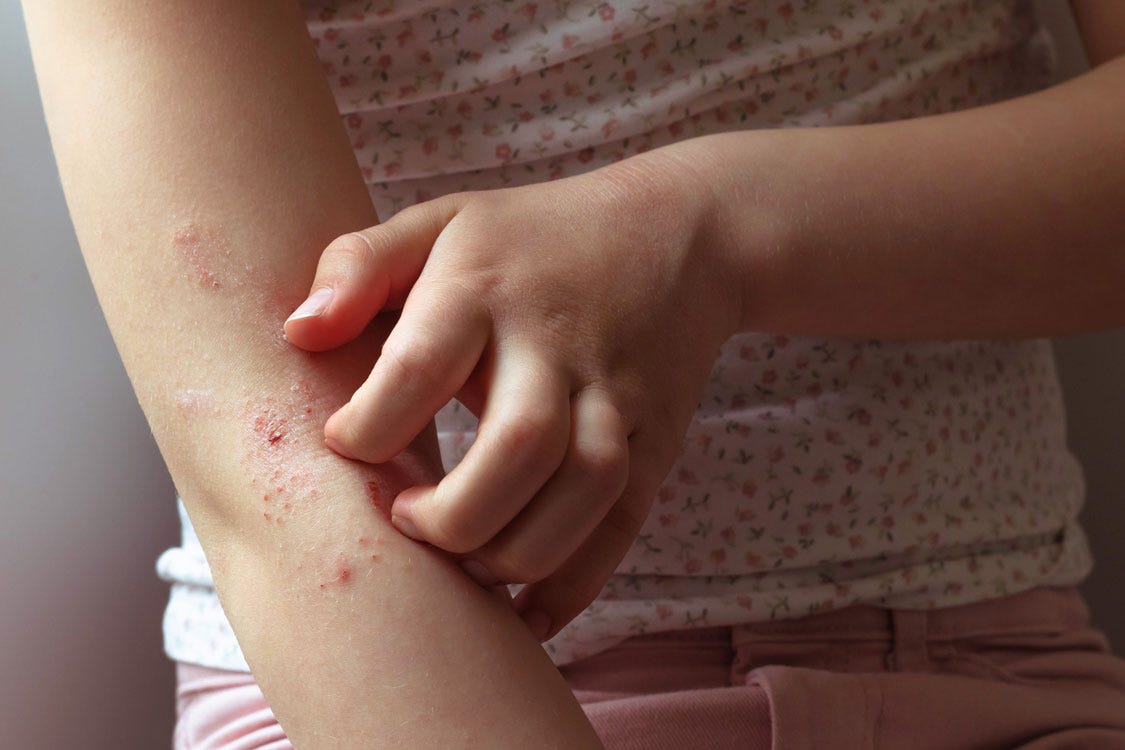
- Redness and inflammation: Reddened, dry, scaly and often weeping patches of skin that appear on the arms, legs and face.
- Restless sleep: The itching can cause babies to sleep badly or cry more often.
-
Symptoms in young children
- Eczema: This often forms in the bends of the joints (e.g. elbows, knees), on the neck and on the hands.
- Flaky skin: The skin becomes increasingly dry, flaky and rough.
- Leathery skin: In chronic phases, the skin can thicken and become leathery.
- Severe scratching: The itching is severe and agonising, leading to intense scratching and thus to further skin damage.
-
Symptoms ease with age
It is challenging to care for a child with neurodermatitis, so parents are often comforted by the knowledge that the symptoms decrease for many children as they get older.
According to estimates, around 60% of children affected by neurodermatitis show no or only mild symptoms by the time they reach young adulthood. The remaining affected children continue to show signs of atopic eczema into adulthood.
The long-term progression of the disease is unpredictable: it may persist, worsen, disappear, resolve and reappear, or gradually ease over the years until only dry skin remains.
A severe illness in early infancy and a strong family history increase the likelihood of a longer-lasting progression of the disease into adulthood.
The aha! Swiss Allergy Centre offers neurodermatitis training courses for parents and children. The training courses are run by experts from the fields of medicine, nursing, education and psychology to make everyday life easier for children with neurodermatitis and their parents.
How is neurodermatitis in babies and young children treated?
“In treating neurodermatitis, it’s important to ease the symptoms and treat the cause of the inflammation,” says Hartmann. The latter usually requires cortisone-based products to calm the inflammation.
Equally important is regular basic skin care to cleanse and moisturise the skin, strengthening its barrier and preventing new inflammation.
-
Skin care
- Gentle cleaning products: Use mild, fragrance-free cleansing lotions to avoid further irritating the skin.
- Moisturising care: Regularly apply special moisturising care products to the skin to keep it supple and prevent loss of moisture.
- Avoid irritants: Choose clothes made of cotton or silk and avoid wool or synthetic fabrics. You can turn clothes inside out so that the seams are on the outside and remove labels.
-
Medication and local treatments
- Cortisone ointments and creams: Under medical supervision, these can be used to inhibit acute inflammation during flare-ups.
- Calcineurin inhibitors: These are non-hormonal active substances, such as tacrolimus or pimecrolimus, which inhibit an enzyme responsible for the inflammatory reaction of the immune system and which are particularly suitable for longer application.
- Antiseptic ointments: If the weakened skin barrier leads to secondary infections caused by bacteria or fungi, antiseptic ointments can help.
What helps against itching?
The itching is caused by the inflammation underlying neurodermatitis. “There are some immediate measures parents can take to relieve their child’s itching,” says Hartmann.
-
Intensive skin care
Apply moisturising and lipid-replenishing products to your child’s skin several times a day to reduce dryness and rebuild the skin’s barrier function.
Avoid care products that contain fragrances or plant extracts to prevent additional irritation.
-
Cooling
Keeping the skin cool helps reduce itching: Placing cooling compresses and damp cloths on the itchy areas of skin can help.
You can also use gel cooling pads or spoons from the freezer. Wrap the spoons in a tea towel to prevent damage to the skin.
-
Prevent scratching
Keep your child’s fingernails short and clean to prevent them from damaging the skin.
For babies and toddlers in particular, cotton gloves or special pyjamas with integrated mittens can help to prevent children from scratching unconsciously at night.
Pat or pinch the affected areas instead of scratching them.
-
Environmental factors
Ensure optimum humidity in the room (approx. 50-60%) so that your child’s skin doesn’t dry out.
Itching is also exacerbated by high temperatures and sweating. Make sure that your child stays in the shade and is not exposed to the sun, especially during the warmer months. Ensure the rooms are well ventilated so that the temperature is comfortable, especially at night.
-
Are creams containing cortisone suitable for babies and young children?
“Today there are excellent cortisone products for children that show no side effects when used correctly,” says Hartmann. This is confirmed by numerous studies and feedback from university hospitals in Switzerland.
The cortisone contained in creams that are suitable for children acts locally on the skin and is broken down there for the most part. Only very small amounts enter the organism.
“When using cortisone, it’s important that it’s only used for a short time and as prescribed,” says Hartmann. Use of the cream has to be reduced gradually to complete a cycle of treatment.
If several treatments are needed, the skin needs cortisone-free breaks in-between. This helps to avoid side effects, most importantly thinning of the skin,” explains Hartmann.
Several consecutive treatments may be necessary to treat the micro-inflammations in the skin – and thus reduce the risk of further flare-ups.
Hartmann also mentions that parents are often reluctant to apply enough cortisone. She explains that, if a cortisone preparation is prescribed, it is important to apply the right amount to the skin.
But how much is needed? “A strip of cream along the length of an adult’s index fingertip is sufficient to treat an area of skin the size of two handprints,” says Hartmann.
This is known as a fingertip unit. This formula applies to all types of local treatment of atopic eczema.
Home remedies: what helps with neurodermatitis?
Hartmann advises that home remedies always be used with caution, because some of the recommended remedies, such as chamomile or oats, may irritate the skin further and trigger allergies.
Experts therefore recommend that home remedies are first tried on a small patch of healthy skin.
-
Tea tree oil
Tea tree oil, a traditional Aboriginal remedy from Australia, is known for its antiseptic effect.
However, experts are cautious when it comes to neurodermatitis: “Tea tree oil can burn on the skin, particularly in young children,” says allergy expert Hartmann. This can cause additional irritation.
If you want to try it, pay attention to the quality of the tea tree oil when buying it. It should be 100% pure and organic. Also make sure that the plant genus Melaleuca alternifolia is mentioned on the label.
A high proportion of the active ingredient terpinen-4-ol (at least 30%) and a low proportion of cineole (less than 5%) are crucial for the best effect.
-
Aloe vera
Fresh aloe vera gel from the leaf or as a ready-made product has a moisturising, anti-inflammatory and cooling effect.
Applied directly to affected areas, it reduces itching and redness.
-
Coconut oil
Coconut oil has anti-inflammatory, antimicrobial and moisturising properties. These can be helpful in treating neurodermatitis.
Studies show that coconut oil improves the skin barrier, reduces water loss through the skin more effectively, and is better at relieving the symptoms of eczema than mineral oil. It can reduce the feeling of tightness, ease itching and soothe inflammation.
However, some experts point out that coconut oil doesn’t penetrate very deeply and could dry out the skin with long-term use.
The tolerance of coconut oil depends on a person’s skin type. It is important to test the tolerance on a small patch of skin and use high-quality cold-pressed organic coconut oils.
-
Lipid-replenishing oils
Natural, lipid-replenishing oils such as almond oil, jojoba oil or evening primrose oil support the skin’s lipid layer and can nourish dry patches of skin.
“Although these oils help supply the skin with oil, this isn’t enough for skin affected by neurodermatitis,” says Hartmann. It needs moisture – and that’s missing from these oils.
-
Homoeopathic remedies
These remedies can be a useful supplement to conventional medicine, but never replace it.
Commonly used homoeopathic remedies for neurodermatitis include:
- Belladonna C 200: Especially recommended as an initial dose for acute eczema
- Sulphur C 30: Applied if Belladonna fails to bring about any improvement after around 10 days
- Vaccination nosodes, such as Iso-Infanrix-Quinta C 200, if neurodermatitis occurs after a vaccination
- Complex remedies consisting of Viola tricolor (wild pansy), Corallium rubrum (precious coral) and Cicuta virosa (water hemlock) are said to ease itching, scaling, erythema and seeping
-
Black tea compresses
Compresses made with cooled black teabags can alleviate inflammation and reduce itching due to the tannins contained in the black tea.
Boil the teabags, let them cool and then lay them on the skin.
-
Cooling compresses
Use clean hand towels and clean water to create cooling compresses.
You can also apply damp ointment dressings. To do so, apply the ointment to the skin, followed by a bandage that has first been moistened with cool water. This moisturises and relieves itching.
How much does diet matter?
Most parents of children with neurodermatitis often blame the child’s diet when a flare-up occurs – and feel guilty. But “most flare-ups aren’t a result of a food allergy,” says Hartmann.
External triggers of a flare-up typically enter the body through the skin – and come into contact with the immune system that way. However, the triggers for a flare-up vary from one person to another and can change over the course of a person’s life.
“Often, several factors influence the skin’s condition, which is why it can be difficult to find out what triggers a flare-up,” says Hartmann. Identifying a specific trigger is not always necessary to treat neurodermatitis successfully.
However, a flare-up can increase the risk of food intolerance – when allergens (usually in proteins) from certain foods enter the body through the weakened skin barrier. The immune system recognises these substances as foreign and can react to them.
The skin thus develops a so-called sensitisation, that is, an increased sensitivity to the foods containing these proteins. If the affected person eats these foods again later, their immune system can react and a food allergy develops.
“That’s why it’s important to take good care of the skin and treat eczema consistently, so that the skin barrier remains stable and such sensitisation is prevented as far as possible,” explains Hartmann.
Certain foods, such as citrus fruit or tomatoes, may irritate the skin around the mouth. Instead of avoiding these foods entirely, Hartmann advises parents to apply cream to the area around the child’s mouth liberally before eating.
When it comes to nutrition, the rule of thumb is to eat normally rather than avoid specific foods. “We recommend that infants with neurodermatitis should try out foods normally, just like any other child,” says Hartmann. Allergy tests are recommended only when there is a clear suspicion.