Tai chi: what are the health benefits?
With its slow, flowing movements, mindful breathing and inner peace, tai chi is far more than just exercise.
Key points in brief
- Tai chi is an ancient Chinese martial art that combines movement, breathing and mindfulness.
- It typically features slow, flowing movements, an upright posture and a focus on coordination instead of strength.
- Studies show that it has a positive effect on balance, mobility, well-being and stress levels.
- Tai chi is safe and is suitable for almost everyone, regardless of age or fitness level.
Even before the thoughts in your head stop circling, your body begins to move. Slow, flowing, almost silent.
When you watch tai chi for the first time, you see people who appear to be fighting an invisible resistance, yet remain completely present. This is precisely the essence of this centuries-old practice.
What is tai chi?
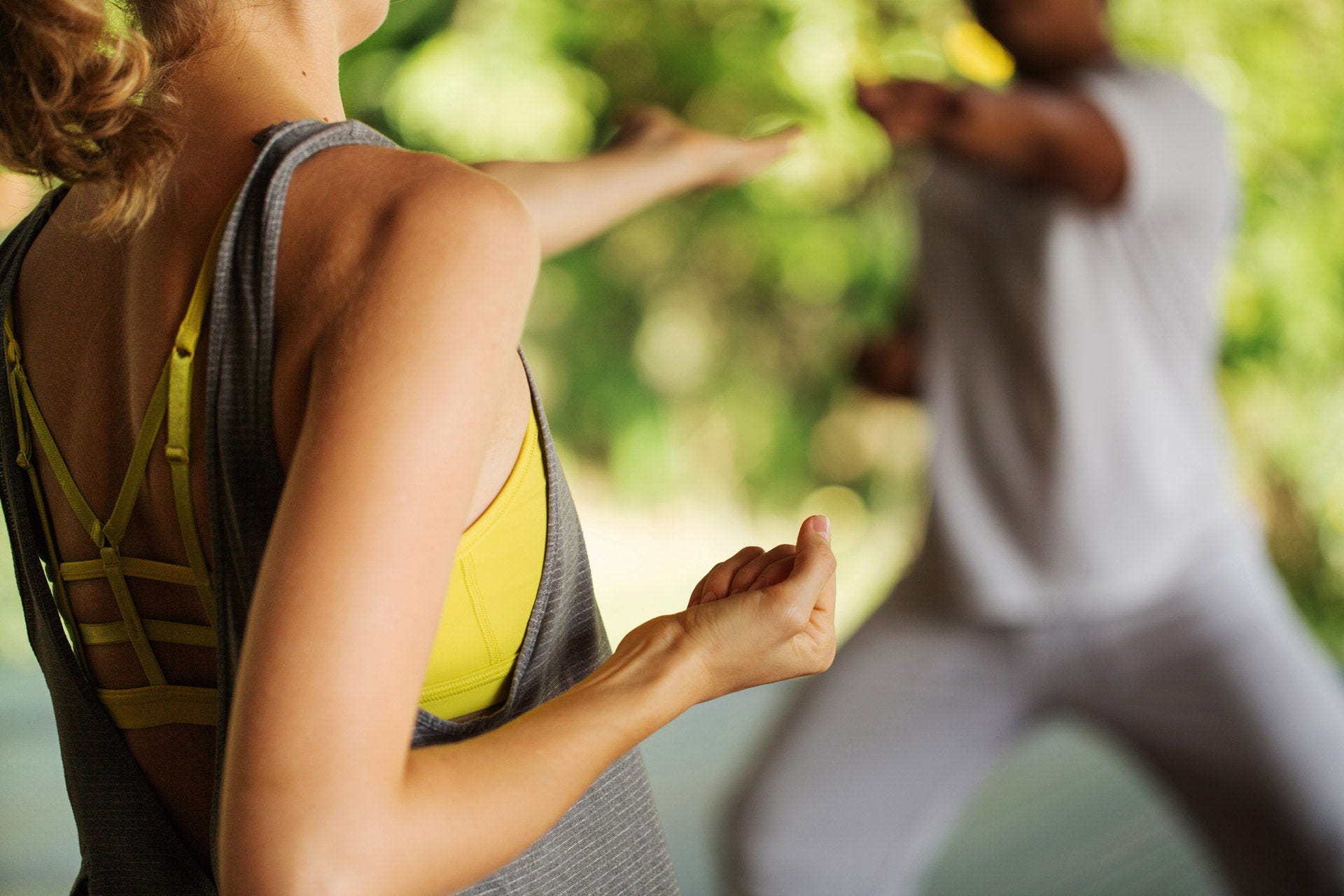
Tai chi is a martial art that comes from China. Today it is practised worldwide as a gentle form of exercise for body and mind. Tai chi combines movement, breathing and mindfulness.
At its core, tai chi is moving meditation. The exercises consist of slow, flowing sequences of movements that require concentration and mindfulness. Breathing, posture and movement are interconnected. The body and mind work in harmony.
The aim is to allow the life energy – the Qi – to flow harmoniously through the body. Tai chi follows the Daoist principle of yin and yang: Opposites complement each other and should be brought into balance.
What is the difference between qigong and tai chi?
Qigong and tai chi are both rooted in Chinese philosophy and both work with breathing, movement and inner focus.
However, qigong is an umbrella term for many methods that involve both movement and static postures, while tai chi consists of fixed, related sequences of movement.
What are the main characteristics of tai chi?
A tai chi unit, often referred to as a form or routine, is a choreographed sequence of movements. A sequence can take up to 90 minutes. Many positions have poetic names and are ideally first learned under expert guidance.
The movements are typically very slow, flowing and look like they are being done in slow motion. This requires concentration, body control and being present. Every movement flows consciously into the next one, without abrupt transitions.
A straight, relaxed posture is key. Head, spine, shoulders and hips are loosely aligned, the stance consciously alternates between “full” and “empty”. Movements arise from the core, not from isolated muscle strength.
Instead, the focus is on the coordination of the whole body: the movement starts in the feet, transitions to the legs and hips, and on to the arms and hands. The upper body and lower body work as a unit.
Continuity is another important feature of tai chi. All movements form a continuous flow; without interruption or standstill. But the mind remains calm, with tai chi combining movement with inner concentration and meditative awareness.
What are the health benefits of tai chi?
The effectiveness of tai chi depends greatly on your state of health when you begin. The U.S. National Center for Complementary and Integrative Health regularly evaluates studies, with varied results. The research is convincing for some effects, but must be interpreted with caution for others.
- Balance and fall prevention: Most research has been done into the effects of tai chi on older people. A 2019 review indicates that regular tai chi reduces the fall rate by around 19%.
- Mobility and physical function: Medical associations expressly recommend tai chi for knee and hip arthrosis. Study participants report less pain and stiffness and improvements in everyday movements, such as walking, standing up and climbing stairs.
- Pain relief for chronic complaints: Reviews suggest that tai chi can help alleviate pain associated with back pain, fibromyalgia, and knee arthrosis. Improvements in quality of life, sleep quality and fatigue have also been observed, particularly in fibromyalgia. However, researchers emphasise the need for larger studies.
- Stress reduction and mental well-being: Several studies show small but measurable effects on depressive symptoms and quality of life – especially in older people with chronic illnesses. Tai chi has a similar effect to other gentle forms of exercise.
- Cognitive abilities in old age: Studies of older people with mild cognitive impairment suggest that tai chi – especially when combined with cognitive tasks – can improve attention, memory and executive functions.
- Cardiovascular health: In people with cardiovascular disease, reviews found evidence of increased performance. Studies have also shown that tai chi can be more effective than exercise or medication in managing high blood pressure.
- Metabolism: Several studies report improved blood sugar values in people with type 2 diabetes. Tai chi was found to be better than no exercise, but usually no more effective than other forms of endurance training.
- Quality of life with chronic diseases: With COPD and other chronic diseases, studies show evidence of improved resilience, lung function and quality of life. Tai Chi performed better than no treatment in some cases, and was as effective as other gentle forms of exercise.
The National Center for Complementary and Integrative Health points out that many of these studies are small, short-term or focused on different methods. Therefore, tai chi shouldn’t be seen as a miracle cure, but rather a well-tolerated form of exercise with a broad – though variably well-documented – range of effects.
What are the disadvantages of tai chi?
Overall, tai chi is a very safe form of exercise. A review study with almost 1,800 participants showed that tai chi didn’t cause more side effects than other forms of exercise.
Most of the reported complaints were mild, such as sore muscles or joint pain. No serious incidents were attributed to tai chi.
Disadvantages are more likely to occur with regards to the practice of tai chi, with no uniform training standards in place for instructors.
And, despite the gentleness of the movements, exercises should be adjusted to suit individual requirements. Ignoring your own limits or practising without guidance may result in injury.
For whom is tai chi suitable and for whom is it not?
Tai chi is suitable for people of all ages – including children and senior citizens – as well as for people with disabilities or chronic illnesses.
The movements can be adapted to suit any fitness level: from very slow and gentle to dynamic. Individual principles can also be used for people with limited mobility.
Anyone can have a go. Experts therefore classify tai chi as very safe. Side effects are rare and usually mild.
There is a lack of high-quality studies on the effects of tai chi alone for pregnant women. Experts therefore recommend seeking medical advice before starting and using individually tailored offers.
Tai chi for beginners: how do I get started?
Tai chi classes are readily available and can be started without previous experience. You don’t need equipment or much space. And tai chi can be done indoors and outdoors, standing or sitting.
All you need is a quiet space in which you can perform the movements mindfully and without rushing.
Instead of learning a whole sequence straight away, it is advisable for beginners to start with a few simple movements and practise these regularly.
The movements should flow smoothly into one another and be coordinated with calm, deep breathing. The important thing here is not perfection, but paying attention to posture, breathing and the flow of movement.
If you want to practice tai chi for a longer period of time, you will benefit from a course with a qualified teacher to avoid incorrect postures and learn the basics correctly. This is especially true for people with health restrictions.
Simple tai chi exercise to do at home
- Find the starting position: stand up straight with your feet about shoulder-width apart. Distribute your weight evenly between both feet, keep your knees loose and your arms relaxed at your sides. Look straight ahead.
- Raise your arms slowly: breathe in calmly through your nose and slowly raise both arms forward to about shoulder height – only as far as feels comfortable. Shoulders, elbows and wrists remain loose.
- Let the movement flow: breathe out and lower your arms again in a gentle and controlled manner. The movement should be smooth without jerking or tension.
- Find a rhythm: repeat the sequence several times at a calm pace. Your breathing sets the rhythm, not muscle strength. Make sure that your breath and movement remain connected.
- Take stock: after the last repetition, stand still for a moment and notice how your posture and breathing feel.