Erectile dysfunction: Causes & what you can do about it
When an erection doesn’t happen, it often leads to worrying: Is it stress, age, or an underlying medical condition? Erectile dysfunction is common and can usually be treated effectively.

Key points at a glance
- Erectile dysfunction is diagnosed when the problems persist for at least six months.
- Circulatory problems or other physical conditions are often to blame.
- Depending on the cause, medicine, psychotherapy, or other treatments may help.
Definition: When does it become erectile dysfunction?
Healthcare professionals only diagnose erectile dysfunction (ED) when a man repeatedly fails to achieve or maintain a sufficient erection for at least six months, despite sexual arousal.
As a rule of thumb, when at least two out of every three planned sexual encounters do not take place.
Erectile dysfunction is not the same thing as a low sex drive or an ejaculation disorder. The term “impotence”, on the other hand, is broader and, depending on how it is defined, may also include infertility.
-
How many men are affected by this?
Estimates of how common erectile dysfunction is vary considerably depending on who you ask and how you measure it. A review by researchers at King’s College London shows that international studies report prevalence rates ranging from 3 to 76.5 percent. The researchers attribute the wide range to differences in age groups, definitions, and research methods.
Estimates also vary in Switzerland: According to the Centre hospitalier universitaire vaudois (CHUV), nearly one in two men between the ages of 40 and 70 is affected. The Inselspital Bern estimates that 25 to 50 percent of 60-year-old men and 50 to 70 percent of 70-year-old men are affected. According to the Aarau Cantonal Hospital, 2 to 10 percent of men aged 20 to 40 are affected, although some studies put the figure as high as 26 percent.
-
At what age do erectile problems begin to occur?
Erection problems can occur at any age. Although the risk increases with age, erection problems are not an inevitable part of aging.
Among younger men, stress, performance anxiety, or psychological strain are more common factors. In older men, changes in blood vessels, nerves, and hormones are more often the underlying cause.
Causes: What triggers erectile dysfunction?
For an erection to occur, the blood vessels, nerves, hormones, and the mind all need to work together. If any of these processes is disrupted, the penis may not become sufficiently erect despite arousal. It’s usually an interplay of several different factors:
In most cases, the underlying cause is physical. “Contrary to what is often hastily diagnosed, erection problems only very rarely have a purely psychological cause,” explains Prof. Dr. med. Nicolas Diehm of the Centre for Erectile Dysfunction in Aarau.
-
Age
As we age, narrowing of the blood vessels and changes in nerves and hormones become more common. This can affect erectile function.
-
Medical conditions
Circulatory disorders are among the most common physical causes. Atherosclerosis, diabetes, and high blood pressure can damage blood vessels. As a result, not enough blood flows into the erectile tissue, and the penis remains flaccid.
The situation is different with venous circulatory disorders. “Although enough blood flows into the penis, the veins are unable to retain it, and it flows out again too quickly,” explains Prof. Dr. med. Nicolas Diehm.
Nerve disorders, nerve damage, low testosterone, certain medications or surgery such as a radical prostatectomy can also cause erectile dysfunction. In addition, erectile dysfunction may be a sign of cardiovascular disease and should therefore be evaluated by a doctor.
-
Psychological factors
Especially among younger men, stress, performance anxiety, fear of failure, depression or relationship difficulties can affect erectile function. Psychological factors can trigger erection problems or make existing symptoms worse.
According to Inselspital Bern, psychological factors are the primary cause of erectile dysfunction in around 10% to 15% of affected men. Since physical and psychological factors often interact, both should be taken into account during the medical assessment.
Treatment for mental health conditions can also affect sexual function. Certain antidepressants can reduce sexual desire or contribute to erectile dysfunction.
Self-test: How reliable is your erection?
The International Index of Erectile Function (IIEF-5) uses five questions to assess how reliably an erection is achieved and maintained. Please base your answers on the past four weeks.
-
How confident are you that you can get and maintain an erection?
- Very low
- Low
- Moderate
- High
- Very high
-
During sexual stimulation, how often was your erection firm enough for penetration?
- Almost never or never
- Rarely
- Sometimes
- Most of the time
- Almost always or always
-
How often were you able to maintain your erection after penetration?
- Almost never or never
- Rarely
- Sometimes
- Most of the time
- Almost always or always
-
How often were you able to maintain your erection until the end of sexual intercourse?
- Extremely rarely
- Rarely
- Sometimes
- Most of the time
- Almost always or always
-
How often was sexual intercourse satisfactory for you?
- Almost never or never
- Rarely
- Sometimes
- Most of the time
- Almost always or always
Your responses are evaluated using a standardised scoring system and serve as a guide. A concerning result does not automatically mean that you have erectile dysfunction. However, it may be a good reason to have the symptoms medically assessed.
Treatment: What medical approaches are available?
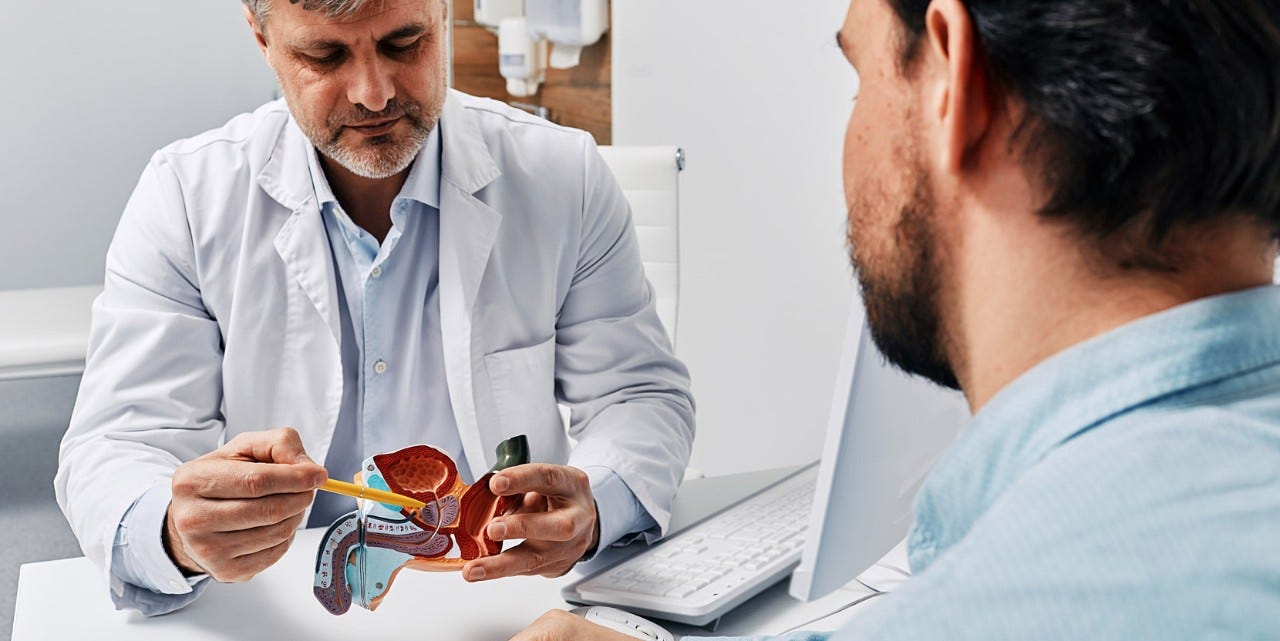
The appropriate treatment depends on the cause and the individual’s needs. Depending on the diagnosis, lifestyle changes, medicine, psychotherapy, mechanical aids, or surgery may be helpful.
-
Medication
PDE-5 inhibitors are usually the first line of drug treatment. They improve blood flow to the penis, making it easier to achieve an erection.
They do not increase sexual desire or address the underlying cause of the problem. Because of possible side effects and drug interactions, they are available only by prescription.
-
Psychotherapy
If stress, depression, anxiety, or relationship difficulties are contributing to the symptoms, psychotherapy or sex therapy may be helpful. Stress and performance anxiety are particularly common contributing factors among younger men.
Psychological and physical factors can also occur together. Therefore, it’s important to identify the underlying causes of erectile dysfunction before beginning treatment.
-
Treatments and procedures
If tablets are not sufficiently effective, intracavernosal injection therapy may be an option. This involves injecting a vasodilating active ingredient into the penis. Once they have been shown how to do it, patients can administer the injection themselves.
With MUSE therapy, a suppository containing the active ingredient is inserted into the urethra to help trigger an erection. Another option is a vacuum pump: it creates a vacuum, causing blood to flow into the penis. A constriction ring placed at the base of the penis prevents the blood from flowing out immediately.
“A further treatment option is to seal the veins using a tissue adhesive,” explains Prof. Dr. med. Nicolas Diehm. If narrowed arteries are the cause and medicine is not sufficiently effective, a balloon catheter or stent can be used to reopen the blood vessels.
If medication and mechanical treatments are unsuccessful, a penile prosthesis may be implanted. A pump system fills the implant with fluid as needed.
Beware of substances bought online
Buying erectile dysfunction medication without a prescription from dubious online suppliers can put your health at risk. The products may contain incorrect dosages, different active ingredients from those listed, or undeclared additives.
A few years ago,Swissmedic examined about 100 erectile dysfunction medications seized by customs. Around three-quarters of them contained the wrong active ingredient or were incorrectly dosed, either too strong or too weak.
The German Consumer Protection Agency also warns against so-called “natural” sexual enhancement products sold online. They may contain synthetic or illegal substances. If prescription-only active ingredients are being sold without a prescription, it’s best not to buy them.
It is therefore safer to seek advice from a doctor or at a pharmacy. Medicines should only be ordered online from reputable mail-order pharmacies authorised by the health authorities.
What does my health insurance cover?
The costs covered by health insurance depend on the treatment you choose. Medicines are covered by basic insurance if they have been prescribed by a doctor, are included on the specialities list, and are used in accordance with the specified conditions.
Not all treatments for erectile dysfunction meet these criteria. In some cases, supplementary insurance may cover part of the costs.
If psychological distress is a contributing factor, psychotherapy may also be covered. Under certain conditions, basic insurance covers up to 30 medically prescribed consultations. Any further treatment requires a commitment to cover costs.
Many people delay seeking medical help because they feel ashamed. An initial consultation by phone or digital means can make it easier to seek help and identify the most appropriate specialist and treatment.
What can I do on my own before I see a specialist?
If you only experience occasional erection problems, you can start by making a few lifestyle changes. If the symptoms recur or persist, you should consult a doctor to rule out any possible physical causes.
-
Strengthen your pelvic floor
During an erection, blood flows into the erectile tissues. Strong pelvic floor muscles help constrict the blood vessels, allowing blood to remain in the penis. This can help maintain a firm erection. Targeted exercises can help alleviate erection problems.
It's not just about contracting the muscles: the key is to alternate between activating and consciously relaxing the muscles.
-
Live healthily
Smoking, lack of exercise, obesity, and excessive alcohol consumption can damage blood vessels and contribute to erectile dysfunction. High blood pressure and diabetes also increase the risk.
Regular exercise, weight loss, and quitting smoking can therefore improve erectile function. It’s also a good idea to drink alcohol in moderation.
-
Reduce stress
Stress and performance anxiety can trigger or worsen erection problems, especially in younger men. Relaxation can help calm both body and mind.
Possible techniques include progressive muscle relaxation, autogenic training, or guided imagery. These can be practised regularly or whenever you experience acute stress.
-
Do home remedies work?
Some natural remedies can help improve erectile function. Studies suggest that ginseng may have potential benefits, although the available data is not strong enough to support a general recommendation.
It’s important to remember: just because something is natural doesn't automatically mean it’s harmless. Herbal supplements can also cause side effects or interact with medicines.
What can I do as a partner?
Erection problems often cause uncertainty for a partner as well. Some people wonder if they’re no longer attractive or if they’ve done something wrong. It’s important to remember: erectile dysfunction is not about blame.
Choose a calm moment to talk about it. An open conversation can help relieve the pressure. Understanding is usually more helpful than pity or well-meaning reassurances. Make space to talk about your feelings and needs, and to explore other forms of sexual intimacy.
Offer your support, for example, by helping your partner find a specialist or by accompanying them to an appointment. After all, closeness, intimacy, and a good relationship are about much more than an erection.
What’s true and what not? Common myths about erectile dysfunction
There are many myths and misconceptions about erectile dysfunction. Because the topic is rarely discussed openly, misconceptions often persist. Let’s separate fact from fiction
-
Myth 1: Erectile dysfunction is a normal part of ageing
Not quite. Although the risk increases with age, erectile dysfunction is not an inevitable part of ageing. It can also affect younger men and often remains treatable later in life.
-
Myth 2: No erection means no arousal – and vice versa
Not true. Sexual arousal and an erection are not the same thing. A man can feel sexually aroused even if he does not achieve a full erection. Conversely, having an erection does not necessarily mean that a man is sexually aroused.
-
Myth 3: You can’t have an orgasm without an erection
That’s not true either. An orgasm is possible even without a fully erect penis. Erectile dysfunction does not necessarily mean that orgasm is impossible.
-
Myth 4: Cycling causes erectile dysfunction
The good news: recent studies have found no link between cycling, erectile dysfunction and infertility, even after long rides. If you experience in your penis while cycling, a better-fitting saddle may help.
Conclusion
In most cases, erectile dysfunction can be treated successfully and is not a personal failure. The causes vary and can range from physical health conditions to psychological stress and lifestyle factors.
It’s important to identify the cause, talk openly about the issue, and seek professional help when needed.
Lifestyle changes, medical treatments and support from those around you can significantly improve your quality of life.